

Project Overview
Portland Parks & Recreation initially approached the Mt. Scott Community Center renewal as a seismic retrofit, but early analysis revealed a broader opportunity: preserve a valued public resource while making it easier to navigate, more accessible, and better equipped for contemporary recreation and community life. FFA developed a mass timber community center design that connects the renovated building and new addition through a clear circulation spine, flexible gathering spaces, and strong relationships to Mt. Scott Park. The completed center pairs the warmth of exposed wood with long-term investments in resilience, energy performance, and adaptability.
Looking Beyond the Seismic Retrofit
The nearly century-old Mt. Scott Community Center had evolved through a series of additions that left programs disconnected and circulation difficult to understand. Visitors arriving from the parking area entered near administrative spaces, searched for the lobby, and sometimes crossed the building again to reach recreation programs. Other areas remained underused, difficult for staff to monitor, or separated from the rest of the center.
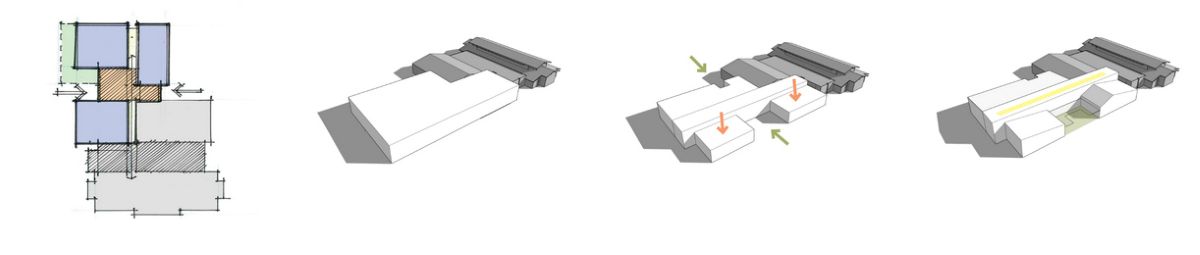
FFA began working with Portland Parks & Recreation in 2019 to assess the building and explore potential improvements. The team developed three concepts with different levels of intervention and compared their effects on program capacity, operations, safety, user experience, and cost. Physical models and clear planning diagrams helped staff and stakeholders evaluate options and identify priorities.
This process showed that seismic strengthening alone would not address the building’s most persistent challenges. Portland Parks & Recreation selected a more comprehensive approach that combined renovation, seismic improvements, and expansion, allowing the center to keep its familiar role while better serving the surrounding community.


Listening to a Center’s Many Communities
Mt. Scott Community Center serves people across generations, cultures, interests, and abilities. Understanding those varied experiences became central to the design process.
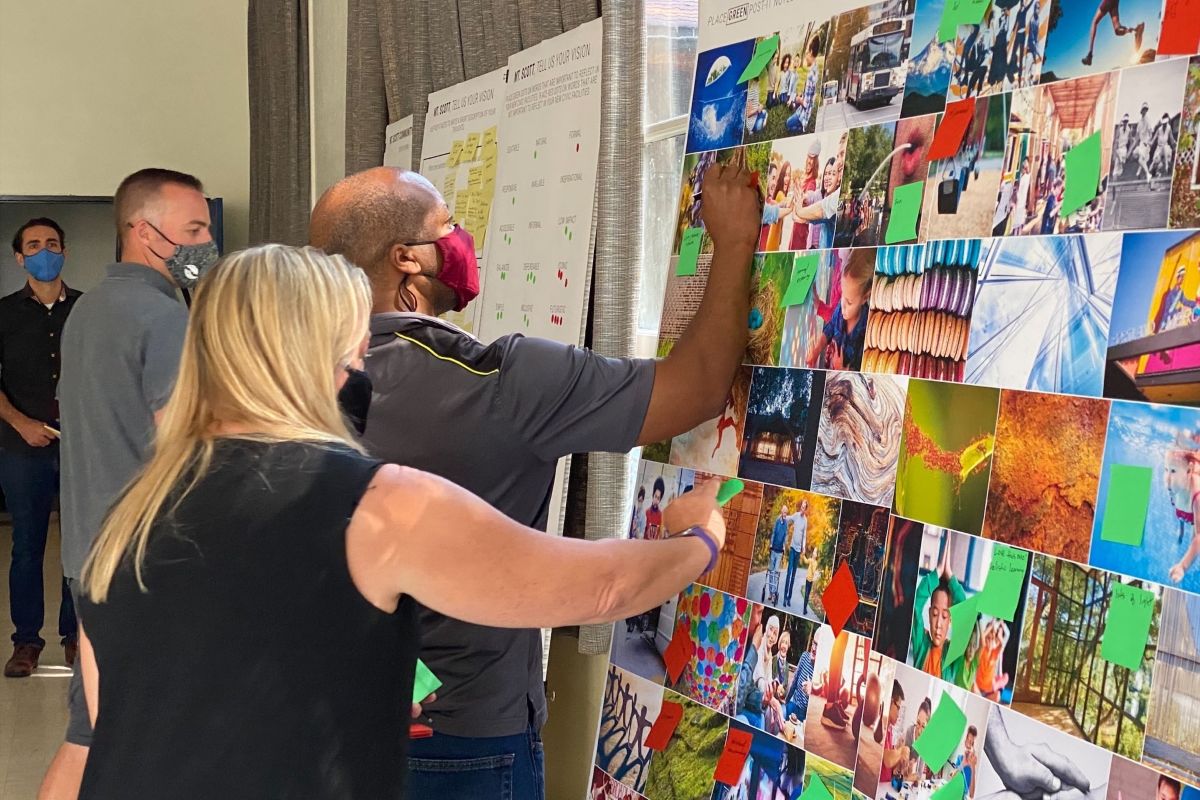
The project team met with Portland Parks & Recreation staff and stakeholders through both virtual and in-person sessions. Community surveys, an open house, a farmers market share-out, and ongoing project updates created additional opportunities for neighborhood participation. Input consistently emphasized the need for a center that felt bright, welcoming, inclusive, and connected to nature. Community members also wanted flexible places that could support art, sports, cooking, meetings, fitness, youth programs, and informal gatherings.
FFA used multiple design options to make the consequences of planning decisions tangible. This iterative approach allowed staff and community priorities to shape the building’s organization, atmosphere, and relationship to the park. As Mt. Scott Community Center Supervisor Adam McGowan later observed, “FFA truly listened to the staff and public, providing warm, welcoming spaces that offer stunning views to the outside.”

Creating a Clear Path Through the Building
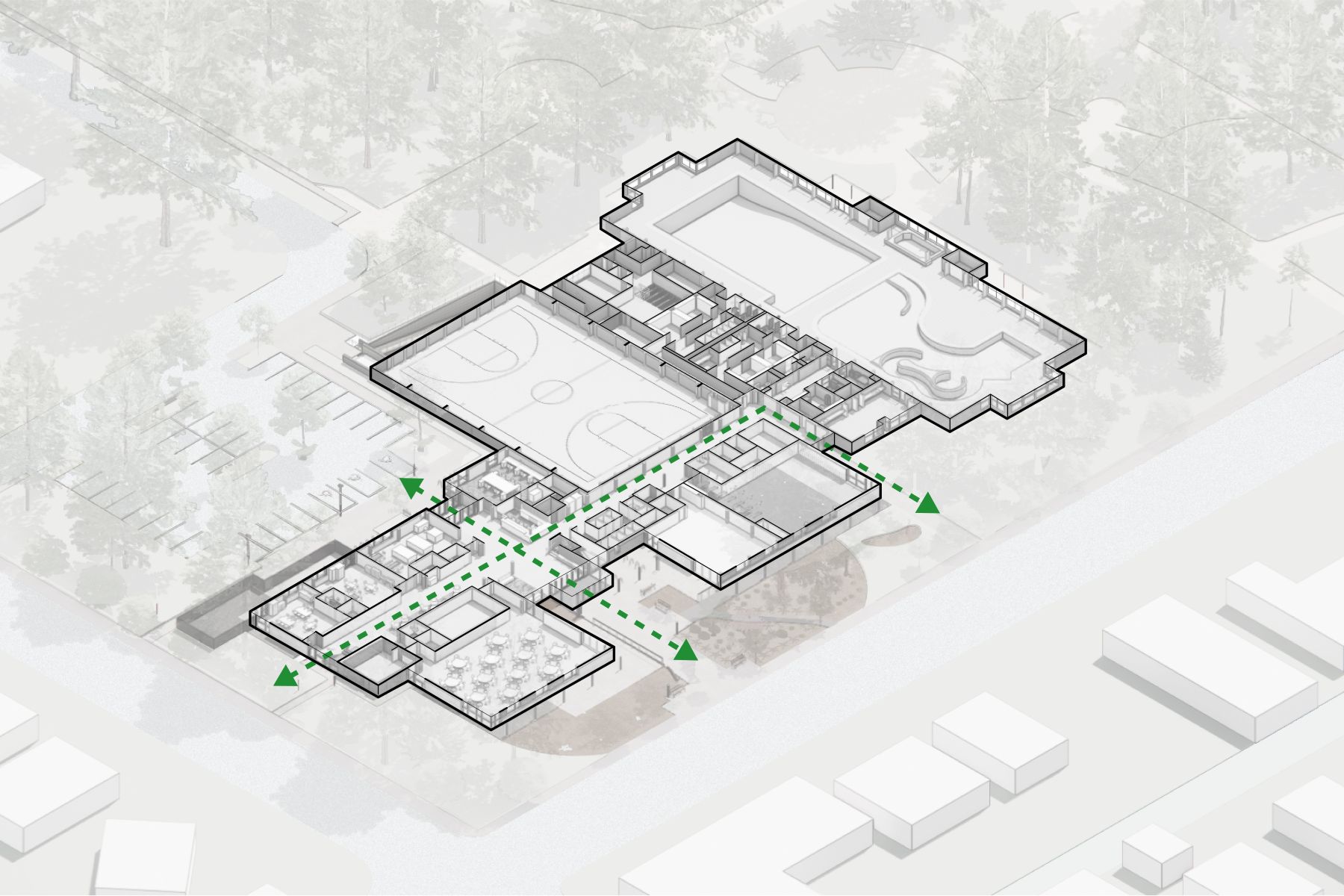
FFA reorganized the center around a clear circulation route that responds to how people arrive. Visitors approaching from the parking area enter from the east, while pedestrians and transit riders use the more civic-facing west entrance. Both routes lead directly to a shared lobby and connect clearly with the center’s primary programs.
The new circulation spine does more than move people through the building. A linear skylight brings daylight deep into the interior, while seating areas give parents, children, neighbors, and program participants places to pause and connect. Exposed timber establishes a warm visual rhythm, and integrated wayfinding helps visitors understand the building without relying on institutional-looking signs or corridors.
Program adjacencies further improve the experience. The fitness center remains easy to reach from the lobby. Staff gained clearer sightlines and stronger connections between work areas and public spaces. Together, these decisions turn circulation into a shared community space rather than a route between isolated rooms.
A Building Shaped by Its Park Setting
The design responds to Mt. Scott Park as both a physical setting and an important part of the center’s identity. FFA approached the building as a “cabin nestled in the woods,” preserving mature trees where possible and shaping the addition around views of the surrounding landscape.
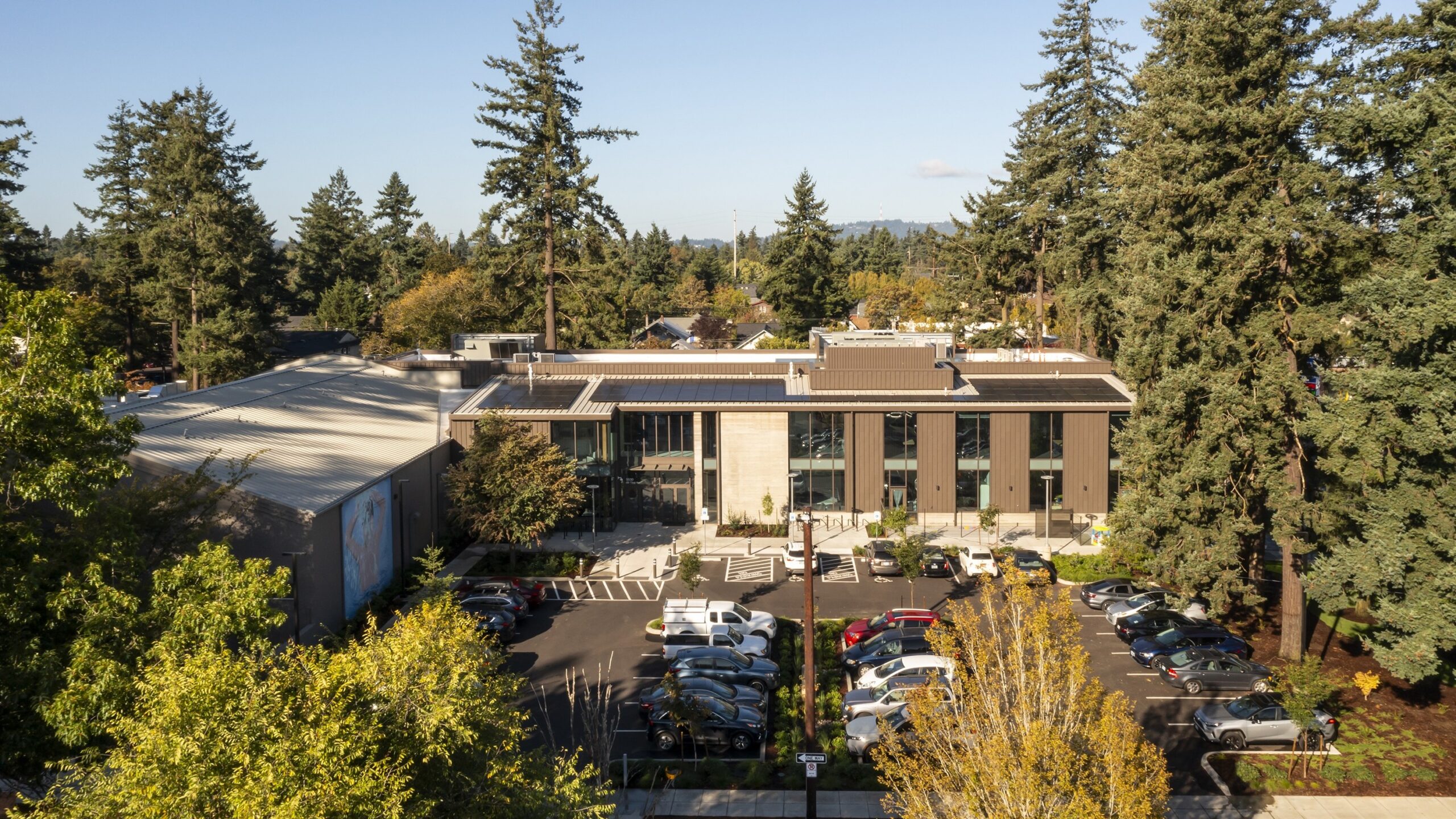
Sloping roofs, deep overhangs, and exposed wood reinterpret elements of the existing building through a contemporary Pacific Northwest expression. The roof forms break down the scale of the 70,000-square-foot facility, helping it relate to the neighborhood while giving larger program spaces a clear civic presence. At night, light from the building reinforces the center’s role as a welcoming destination within the park.
Generous glazing connects the event hall, fitness center, classrooms, and circulation areas with outdoor spaces and established tree canopies. These relationships extend the recreation experience beyond enclosed rooms and support programs that move between indoors and outdoors. Board-formed concrete grounds the building, while timber adds warmth and carries the landscape’s material character inside.

Flexible Rooms for an Evolving Community
Portland Parks & Recreation needed the renewed center to accommodate both established programs and uses that may change over time. FFA organized the addition around adaptable spaces that can support a broad range of community activities without requiring extensive future alterations.
Multipurpose classrooms offer different scales and configurations for arts, education, meetings, youth programs, and other activities. The event hall and commercial kitchen expand opportunities for celebrations, lectures, community gatherings, and food-centered programming. Fitness areas accommodate varied equipment and activity types, while preschool and teen spaces address the needs of distinct age groups.
The design also anticipates changes in how the rooms operate. In-floor power, suspended projectors and speakers, digital signage, and pathways for future technology allow programs to evolve while keeping the architecture orderly and functional. Flexible furniture complements this infrastructure and allows staff to adjust spaces for different group sizes and activities.
These strategies support long-term stewardship and program variety. Adaptable rooms allow the center to respond to changing community needs while reducing pressure for repeated renovations.


Making Mass Timber Work for a Public Project
Cross-laminated timber panels and glulam beams form both the structure and much of the interior finish within the addition. Leaving the wood exposed reduces the need for added finish materials while giving public spaces a warm, durable character. The structural system also establishes a consistent architectural language across corridors, classrooms, fitness areas, and gathering spaces.
Delivering that character within a public budget required disciplined coordination. The project advanced during pandemic-related disruption and construction-cost escalation. FFA worked with Portland Parks & Recreation and the consultant team to reduce costs while protecting the qualities most important to the project. The team narrowed portions of the main circulation route, reduced the number and size of skylights, and simplified roof forms while maintaining daylight, exposed timber, clear organization, and connections to the landscape.
The team coordinated acoustic and lighting systems with equal care. Suspended baffles and wall panels manage sound without concealing the timber structure. The design uses acoustic ceilings selectively in offices and other enclosed areas. Throughout the addition, linear LED fixtures align with the building’s structural rhythm. In the fitness center, placing heavy equipment at ground level helps limit noise and vibration while keeping the double-height space visually open.
Bremik Construction and mass timber installer Carpentry Plus translated this closely coordinated design into the finished building through a hard-bid delivery process.


Access and Resilience Woven into the Design
The project treats accessibility, seismic safety, and climate preparedness as interconnected parts of a durable public resource. Clear routes and intuitive wayfinding make the center easier to use, while a new elevator creates an interior accessible connection to the lower-level roller rink. Previously, visitors moving between the rink and the rest of the building had to use an exterior route through the parking area.
Seismic improvements strengthen the existing center and support its continued use. The new addition expands the building’s capacity while introducing a high-performance envelope and HVAC systems designed to support emergency shelter during extreme weather. Flexible gathering spaces can serve everyday recreation programs while adapting to broader community needs during disruptive events.
The addition operates without natural gas and incorporates a 147-kilowatt photovoltaic array designed to generate renewable electricity. At the entrance, the architecture makes stormwater movement visible as roof runoff travels toward a rain garden, connecting environmental performance with community education.
Together, these strategies support the project’s pursuit of LEED Gold certification. More importantly, they position sustainability as a practical investment in health, continuity, and long-term public service.

Project Impact
Mt. Scott Community Center gives Portland Parks & Recreation a safer, more accessible, and more adaptable setting for recreation and community life. The project preserves a beloved neighborhood institution while removing circulation barriers, expanding programming opportunities, and strengthening its connection to the surrounding park. Positive feedback from staff and community members reflects a building designed to serve both daily activities and changing needs for generations.
70,000 sf
2025 completion
Lara Swimmer